
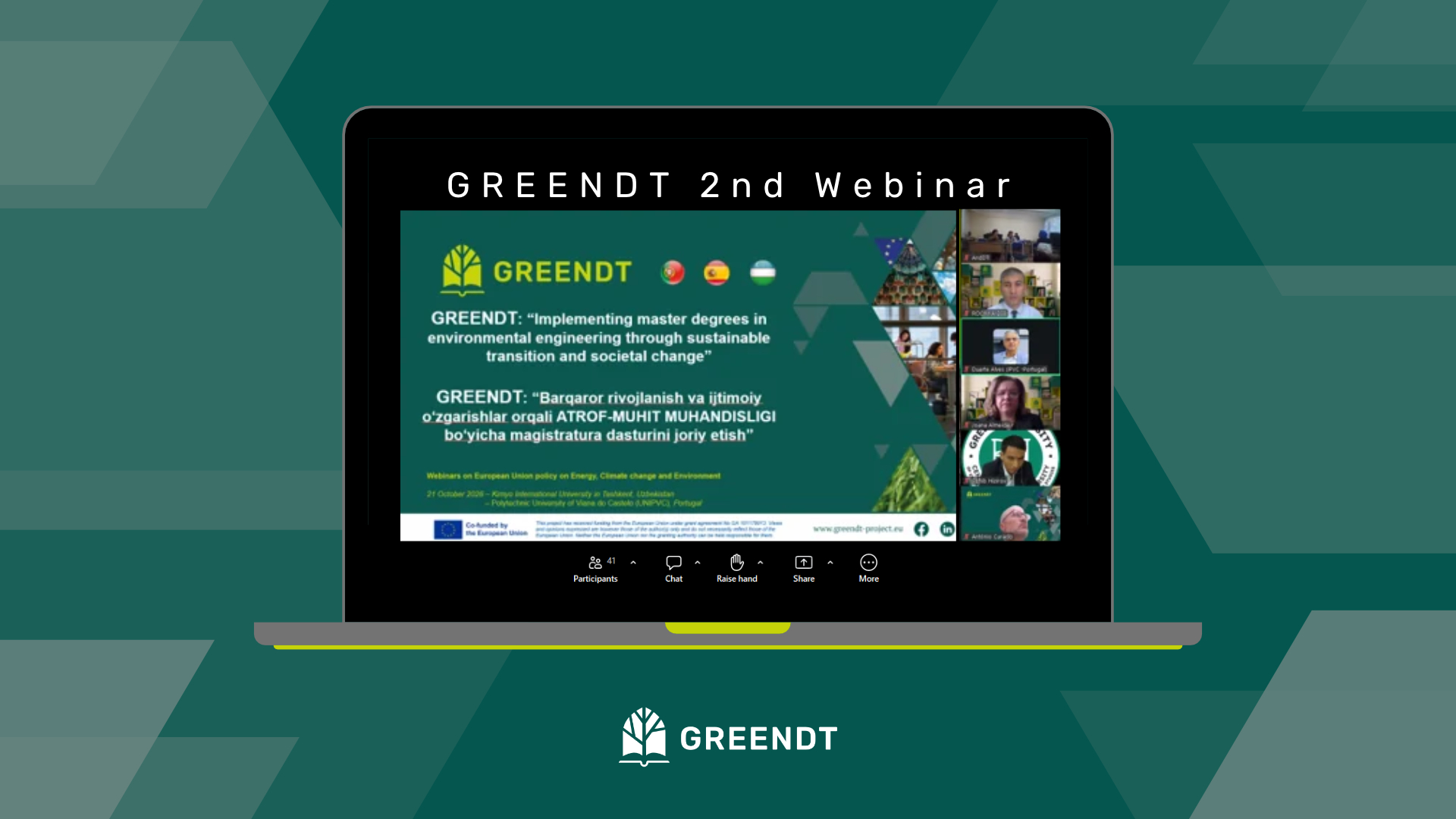

The second GREENDT webinar brings European and Uzbek perspectives on international green cooperation

How can European experience and international partnerships help advance the green transition? This was the main focus of the second GREENDT webinar, held on 21 October 2026 under the title “EU International Green Cooperation”.

The webinar brought together experts from Spain, Portugal and Uzbekistan to discuss European energy and environmental policies, funding opportunities for international cooperation and practical experiences in sustainable engineering.

The session was organised within Task 5.2 – Webinars on European Union Policy on Energy, Climate Change and Environment, The Polytechnic University of Viana do Castelo (UNIPVC), from Portugal, was responsible for the content, while Kimyo International University in Tashkent (KIUT), from Uzbekistan, organised the meeting.

From European energy strategies to international funding opportunities

The programme covered several aspects of international green cooperation, starting with the European Union’s approach to sustainable energy. The GREENDT coordinator, Prof. Duarte Alves (UNIPVC), introduced the EU Strategy for Sustainable Energy, outlining its main priorities and objectives.

Funding opportunities for Central Asian higher education institutions were the focus of the next presentation. Prof. João Domingues (FEUGA) introduced the possibilities offered by Horizon Europe and Erasmus+ Capacity Building in Higher Education (CBHE), explaining how universities can navigate these programmes and explore opportunities to take part in European cooperation initiatives.

The discussion then moved towards sustainable engineering and its practical applications. Prof. António Curado (UNIPVC) presented solutions to current engineering challenges, looking at how European experience and lessons learned could be applied in the Uzbek context.

Prof. Joana Almeida (UNIPVC) shared examples of international cooperation through UNIPVC’s sustainability projects, presenting an overview of its global portfolio alongside specific case studies in environment and energy.

To close the programme, Prof. Sarvarbek Yusupov (KIUT) explored Uzbekistan’s international cooperation opportunities and the potential to build new partnerships around the shared goal of a more sustainable future.

Presentations:

Connecting European and Uzbek expertise

The webinar offered an opportunity to look at the green transition from both European and Uzbek perspectives, highlighting areas where institutions can share knowledge, develop joint initiatives and make the most of international cooperation and funding opportunities.

These exchanges are at the heart of GREENDT, which works to strengthen links between European and Central Asian higher education institutions and support the development of environmental engineering education in Uzbekistan.
GREENDT Advances with Third Train-the-Trainers Workshop in Tashkent, Uzbekistan

Preparation of Didactic Materials on Air Pollution and Climate Change

The GREENDT project continues to advance its mission of transforming environmental and engineering education across Central Asia through its third Train-the-Trainers (ToT) workshop, titled “Preparation of Didactic Materials on Air Pollution and Climate Change.”

Held from 15–17 October 2025 at the Central Asian University of Environmental and Climate Change Studies (Green University) in Tashkent, Uzbekistan, the workshop aimed to strengthen educators’ abilities to design, adapt, and implement effective teaching resources on air pollution, air quality management, and climate change mitigation.

Day 1 – Understanding Atmospheric Emissions and Air Quality Fundamentals

The first day provided a scientific foundation for understanding air pollution dynamics. Participants explored the sources and classifications of atmospheric emissions, the interaction between meteorological conditions and pollutant dispersion, and the principles of air quality assessment.

Hands-on exercises using OpenAir, an open-source analytical tool, enabled participants to visualize and interpret real-world air quality datasets. Through guided practice, they learned to process monitoring data, identify pollution episodes, and generate graphical outputs for teaching and policy discussions. 

Day 2 – Pollutants, Health Impacts, and Atmospheric Chemistry

The second day deepened the focus on the chemical and health dimensions of air pollution. Sessions examined the formation pathways of primary and secondary pollutants, their toxicological effects on human health, and chemical transformation mechanisms occurring in the atmosphere.

Participants engaged with the CLASS model (Chemistry Land-surface Atmosphere Soil Slab) to simulate atmospheric processes such as photochemical reactions and pollutant transport. These simulations served as a basis for developing interactive classroom exercises and case studies that link theory to practical environmental scenarios in Central Asia. 

Day 3 – Monitoring, Modelling, and Climate Interactions

The final day focused on integrating monitoring techniques, modelling tools, and climate change considerations. Participants learned about state-of-the-art air quality monitoring networks, data calibration techniques, and forecasting methods for predicting pollution levels.

Practical sessions on remote sensing and satellite data analysis introduced participants to the use of atmospheric imagery for identifying large-scale pollution patterns and climate feedback loops. Laboratory demonstrations on aerosol sampling and chemical analysis further complemented these digital methods, helping educators translate complex scientific tools into accessible learning experiences.

The day concluded with a collaborative session to review and refine the didactic materials developed throughout the workshop. Participants discussed how to integrate these resources into existing curricula, ensuring that future engineers and environmental scientists gain both theoretical knowledge and practical analytical skills. 

Towards Sustainable Air Quality Education

This third ToT workshop marked a major milestone in GREENDT’s effort to empower educators and researchers with advanced methodologies for teaching air pollution and climate change. By combining scientific depth, data-driven analysis, and applied learning, the workshop equipped participants to produce high-quality educational materials that will enhance environmental education across the region.

Through this initiative, GREENDT continues to build a network of trainers capable of fostering sustainability-focused education and supporting evidence-based decision-making in air quality and climate management — contributing to a cleaner, healthier, and more resilient future for Central Asia and beyond.