
GREENDT completes the internal training sessions to strengthen Environmental Engineering Education in Uzbekistan

The GREENDT project has successfully completed the set of internal training sessions outlined within Work Package 5, marking an important milestone in the project’s capacity-building activities. Building on the Training of Trainers (ToT) programme previously delivered by the European partner institutions, the sessions enabled the trained academic staff from the Uzbek universities to transfer their knowledge and experience to their colleagues within their own institutions.

Building on the Training of Trainers Programme

As planned, each Uzbek partner institution organized at least three internal training sessions during the first half of 2026, ensuring the effective transfer of knowledge acquired through the Training of Trainers programme. Kimyo International University in Tashkent (KIUT) delivered four training sessions in April, including a dedicated session involving external stakeholders. Andijan State Technical Institute (ASTI) and Fergana State Technical University (FSTU) each organised three sessions in March, while Jizzakh Polytechnic Institute (JizPI) conducted its three sessions in February. Central Asian University of Environment and Climate Change Studies (CAGU) completed its three planned sessions in May, bringing the implementation of the training programme to a successful conclusion across all partner institutions.

These training sessions targeted academic staff, researchers, administrative personnel and other stakeholders involved in the development and delivery of the new Master’s programmes in Environmental Engineering. Through this multiplier approach, GREENDT has expanded the impact of the knowledge acquired during the ToT activities, building institutional capacity and promoting the adoption of innovative teaching practices.

The programme covered a wide range of topics related to Environmental Engineering and Sustainability, including:

  • European environmental policy.
  • Engineering diplomacy.
  • Equity and inclusion.
  • Water management.
  • Sustainable energy.
  • Geographic Information Systems (GIS).
  • Risk assessment.
  • Atmospheric pollution.
  • Air quality monitoring.
  • Climate change.

The training materials developed throughout the project were adapted to the needs of each institution, ensuring their effective integration into local teaching and learning environments.

Beyond the technical content, the sessions promoted active participation, knowledge exchange and the dissemination of European pedagogical approaches. Particular attention was also given to fostering inclusive learning environments by integrating principles of equity, diversity and accessibility into the design and delivery of the training activities.

Strengthening Capacity for Long-Term Impact

The implementation of the internal training sessions was followed by participant feedback and evaluation processes, providing valuable insights into the effectiveness of the activities and helping identify lessons learned and recommendations for future capacity-building initiatives. The overall outcomes confirmed the relevance of the training programme in strengthening institutional expertise and supporting the modernisation of Environmental Engineering education in Uzbekistan.

The successful completion of these activities represents another significant achievement for GREENDT, reinforcing the project’s long-term objective of enhancing higher education through international cooperation, knowledge transfer and the adoption of European best practices.

Erasmus+ Week 2026 opens registration for a week of opportunities in Uzbekistan

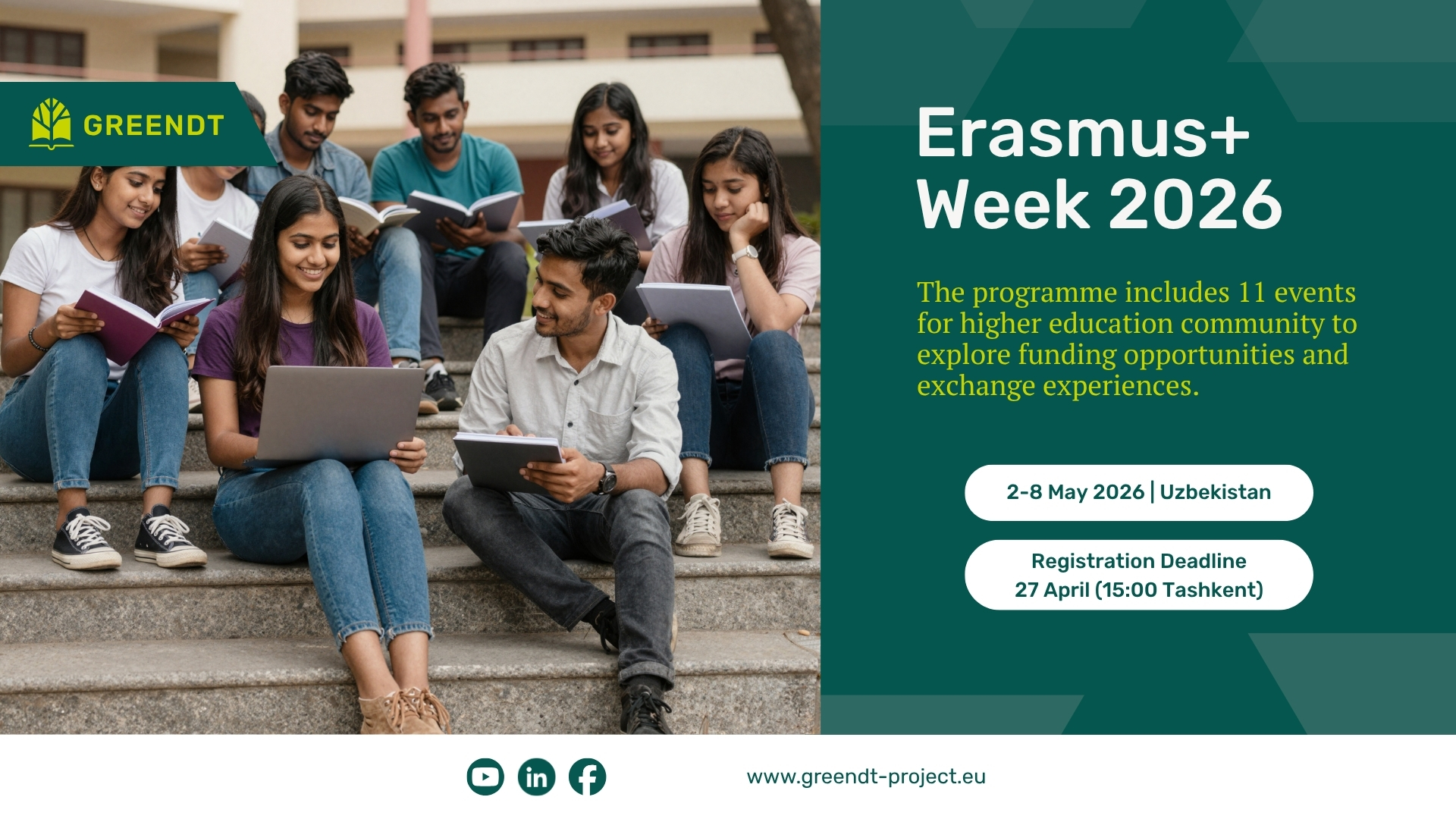
The Erasmus+ Week 2026 has officially opened its registration period, inviting participants to explore the wide range of opportunities and achievements of the Erasmus+ programme. Taking place from 2 to 8 May 2026, this week-long initiative will bring together students, academics, and professionals interested in international cooperation and higher education, with a particular focus on activities across Uzbekistan.

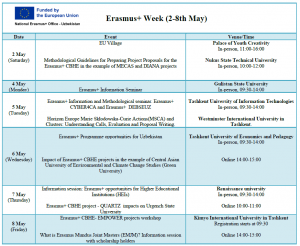
During the week, a total of 11 events will be held, including 8 in-person sessions across different regions of Uzbekistan and 3 online events, allowing flexible participation depending on availability. The programme will feature presentations on Erasmus+ opportunities, showcases of project results, and an online exhibition highlighting Capacity Building in Higher Education (CBHE), Jean Monnet, and International Credit Mobility (ICM) projects. In addition, participants can attend information seminars, thematic sessions, interviews, and a dedicated session on Marie Skłodowska-Curie Actions opportunities.

The registration deadline is 27 April 2026 at 15:00 (Tashkent time). It is important to note that only registered participants will receive official invitations to attend both in-person and online events. From the GreenDT project perspective, Erasmus+ Week 2026 represents a valuable opportunity to strengthen engagement with the Erasmus+ system in Uzbekistan, fostering new collaborations, and continue promoting knowledge exchange in higher education.
REGISTER HERE