
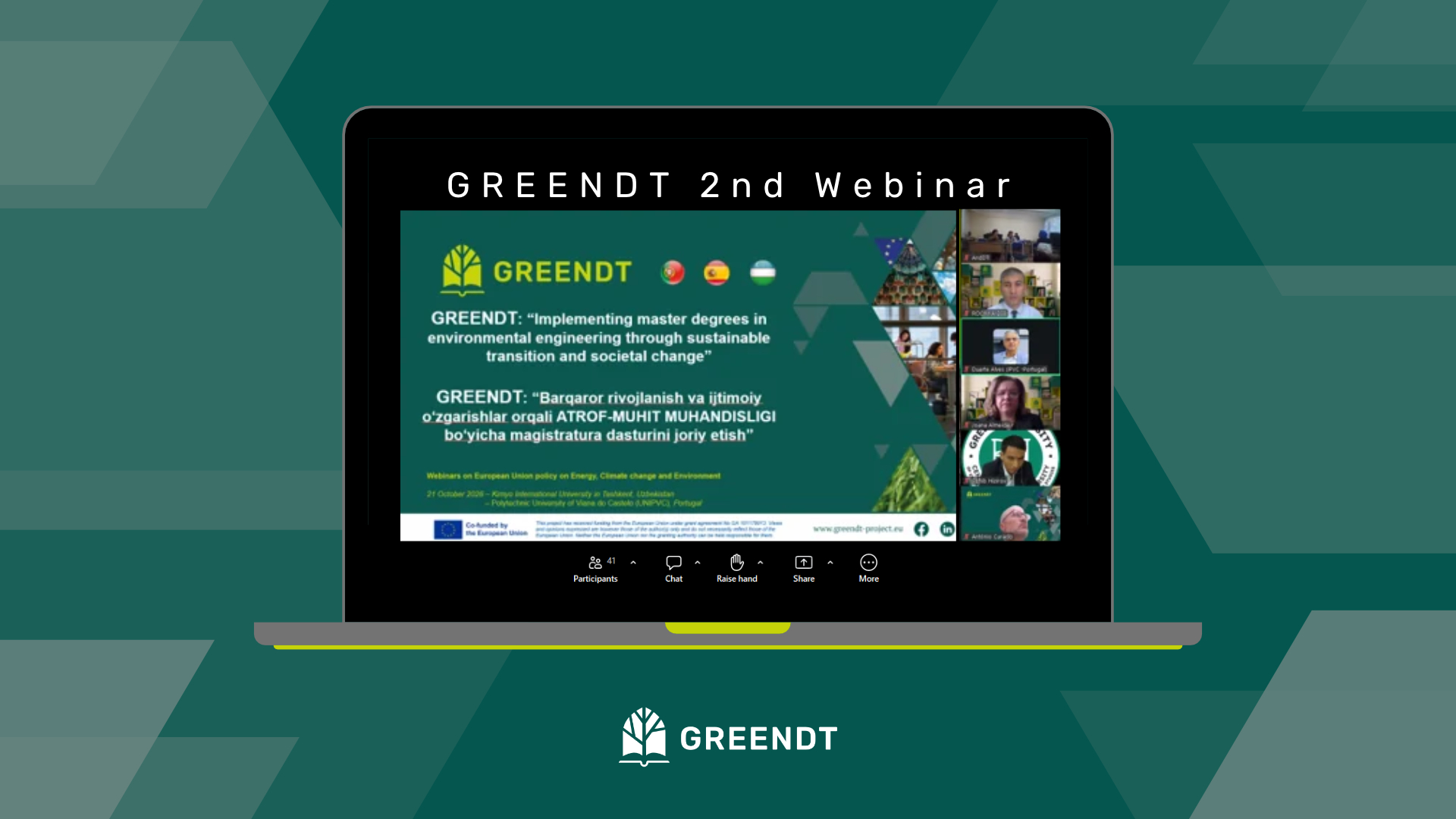

The second GREENDT webinar brings European and Uzbek perspectives on international green cooperation

How can European experience and international partnerships help advance the green transition? This was the main focus of the second GREENDT webinar, held on 21 October 2026 under the title “EU International Green Cooperation”.

The webinar brought together experts from Spain, Portugal and Uzbekistan to discuss European energy and environmental policies, funding opportunities for international cooperation and practical experiences in sustainable engineering.

The session was organised within Task 5.2 – Webinars on European Union Policy on Energy, Climate Change and Environment, The Polytechnic University of Viana do Castelo (UNIPVC), from Portugal, was responsible for the content, while Kimyo International University in Tashkent (KIUT), from Uzbekistan, organised the meeting.

From European energy strategies to international funding opportunities

The programme covered several aspects of international green cooperation, starting with the European Union’s approach to sustainable energy. The GREENDT coordinator, Prof. Duarte Alves (UNIPVC), introduced the EU Strategy for Sustainable Energy, outlining its main priorities and objectives.

Funding opportunities for Central Asian higher education institutions were the focus of the next presentation. Prof. João Domingues (FEUGA) introduced the possibilities offered by Horizon Europe and Erasmus+ Capacity Building in Higher Education (CBHE), explaining how universities can navigate these programmes and explore opportunities to take part in European cooperation initiatives.

The discussion then moved towards sustainable engineering and its practical applications. Prof. António Curado (UNIPVC) presented solutions to current engineering challenges, looking at how European experience and lessons learned could be applied in the Uzbek context.

Prof. Joana Almeida (UNIPVC) shared examples of international cooperation through UNIPVC’s sustainability projects, presenting an overview of its global portfolio alongside specific case studies in environment and energy.

To close the programme, Prof. Sarvarbek Yusupov (KIUT) explored Uzbekistan’s international cooperation opportunities and the potential to build new partnerships around the shared goal of a more sustainable future.

Presentations:

Connecting European and Uzbek expertise

The webinar offered an opportunity to look at the green transition from both European and Uzbek perspectives, highlighting areas where institutions can share knowledge, develop joint initiatives and make the most of international cooperation and funding opportunities.

These exchanges are at the heart of GREENDT, which works to strengthen links between European and Central Asian higher education institutions and support the development of environmental engineering education in Uzbekistan.
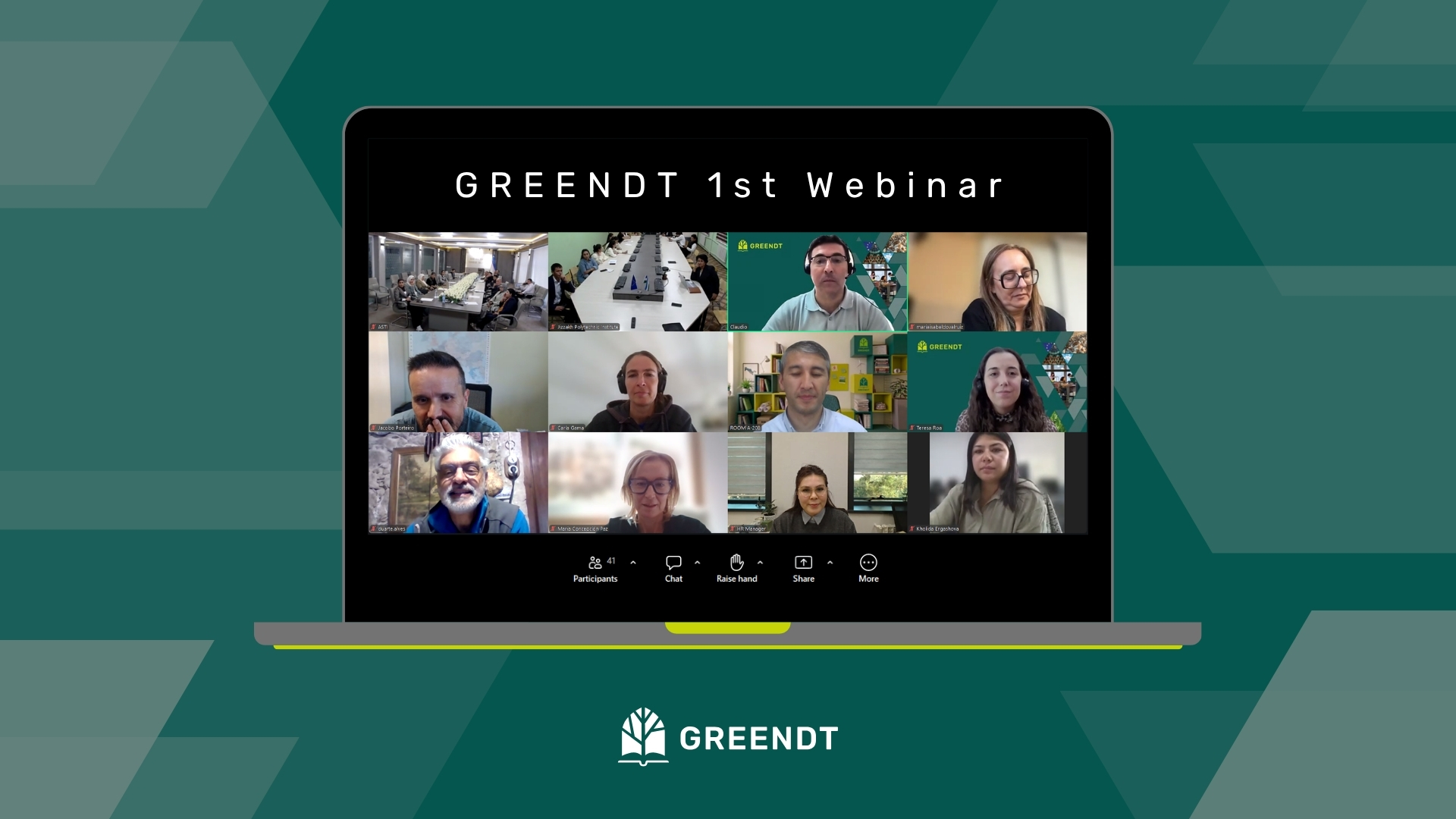

GREENDT launches its webinar series by bringing together European and Uzbek expertise in sustainable engineering

On 13 October, GREENDT held its first webinar, “Green Horizons: Embracing Sustainability and Equality in Engineering Education”, bringing together academic perspectives from Europe and Uzbekistan to explore how sustainability and equality can be integrated into engineering education and adapted to different regional contexts.

The session was organised as part of Task 5.2 – Webinars on European Union Policy on Energy, Climate Change and Environment. The University of Vigo (UVigo), Spain, was responsible for the content, with Kimyo International University in Tashkent (KIUT), Uzbekistan, coordinating its organisation.

Sustainability and the European Green Deal in engineering education

The programme covered several aspects of the green transition, combining a local perspective on Uzbekistan’s challenges with European experiences and approaches to sustainable engineering.

Prof. Sarvarbek Yusupov (KIUT) opened the programme by explaining the series of webinars and also addressing Uzbekistan’s challenges and the green transition in higher education institutions. The following sessions, led by professors from UVigo, explored different dimensions of sustainable engineering and its application.

Prof. Claudio Cameselle discussed solutions to current engineering challenges, their application in Uzbekistan and lessons learned from Europe. Prof. Jacobo Porteiro then introduced the European Green Deal, focusing on the vision of a climate-neutral Europe, its key strategies and their potential adaptation to Uzbekistan’s policy context.

The programme also examined the importance of interdisciplinary collaboration. Prof. María Isabel Doval explored how systems thinking and cross-disciplinary knowledge can contribute to sustainable engineering, while Prof. Teresa Roa presented regional success stories and approaches to adapting successful practices to different contexts.

Finally, Prof. Concepción Paz Penín addressed inclusivity and gender equity in engineering education, focusing on relevant frameworks and institutional best practices.

Check out the presentations below to learn more about the topics covered in each intervention:

The webinar series continues on 21 October

The next GREENDT webinar will take place on 21 October 2026, under the title “EU International Green Cooperation”. The session will be led by the Polytechnic University of Viana do Castelo (UNIPVC), Portugal, with Kimyo International University in Tashkent (KIUT), Uzbekistan, coordinating its organisation.

The webinar will explore the European Union’s approach to international green cooperation, covering climate action, environmental sustainability and international partnerships. It will also look at opportunities to strengthen cooperation between European and Uzbek institutions, bringing together representatives of the GREENDT consortium, partner universities, experts and other relevant stakeholders.

Date: 21 October 2026
Time: 13:30-16:30 (Uzbekistan) / 10:30–13:30 (Spain) / 09:30–12:30 (Portugal)

Interested in joining? Register for the webinar here.

Through this series, GREENDT aims to encourage knowledge exchange between European and Central Asian higher education institutions and support the integration of sustainability into engineering education.